
Modern Slavery Statement
Multigate structure, operations, and supply chains
This statement is made pursuant to the Commonwealth Modern Slavery Act 2018 (Cth) and outlines the actions taken by Multigate Medical Products Pty Ltd (“Multigate”) during the financial year ending 30 June 2025 to identify, assess, and address risks of modern slavery in our operations and supply chains.
1. About Multigate
Multigate is a leading manufacturer and supplier of surgical procedure packs and other medical devices for the public and private hospital market.
Multigate’s core business is a wholly Australian owned, Australian-based manufacturer of medical products. It employs approximately 450 people, the majority of whom work at the company’s head office and manufacturing site at Villawood in New South Wales.
Our operations include:
· Manufacturing facilities in Australia, New Zealand and offshore
· Distribution networks across hospitals and healthcare providers in
Australia and New Zealand
· Partnerships with suppliers in Asia-Pacific and Europe
Our supply chain includes raw material suppliers, packaging providers, logistics partners, and contract manufacturers.
2. How Multigate identifies the risk of Modern Slavery
2.1 Identifying risk across the supply chain
Multigate recognises that the highest risk of modern slavery may exist in relation to supply chain and shipping. The areas of vulnerability are:
· Raw material sourcing (e.g., cotton, plastics)
· Offshore manufacturing in countries with:
o culturally different labour and social expectations
o government controlled labour markets and/or government sanctioned forced labour practices
o absence of worker access to legal protections
o absence of worker access to legal enforcement protocols
· Third-party logistics, shipping and warehousing
o Historically, merchant shipping has weak worker protection due to multi-jurisdictional issues and resultant lack of monitoring or enforcement capabilities
We conduct regular risk assessments focusing on geographic, sectoral, and product-specific vulnerabilities.
2.2 Identifying geographical areas at risk
As some Multigate entities and suppliers have operated in countries that are rated below Tier 1 environments for labour practices by the US Department of State’s Trafficking in Persons Annual Report, it is aware that vigilance is required when sourcing materials from these countries as there is a potential modern slavery risk which may include involuntary servitude, debt bondage or slavery. These include countries such as China, Malaysia, and Pakistan.
Map of countries in Multigate’s supply chain
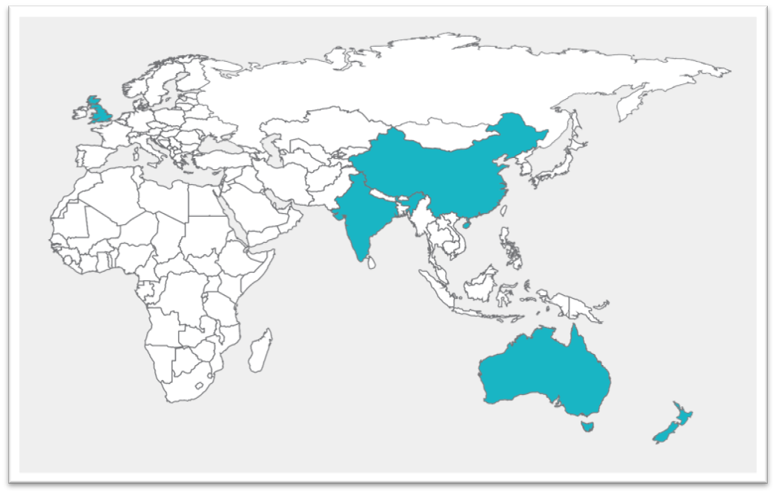
This map indicates the countries which Multigate may have supply or other commercial relationships.
Map of Prevalence
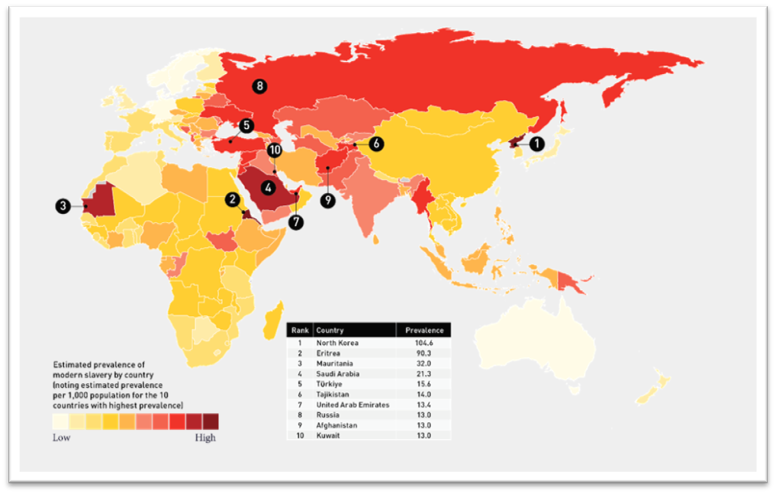
This map shows countries coloured according to the prevalence of modern slavery.
Map of Vulnerability: Link - World | The Global Slavery Index [2023]
2.3 Identifying companies at risk
Multigate has identified the risk of modern slavery being hidden in the supply chain where suppliers use undeclared third-party manufacturers. We are cognisant that this is a business practice in countries where the purchasing is done through trading companies rather than by buying from more established manufacturers directly. Multigate deliberately avoids the use of trading companies so we can lower the risks, both ethical and commercial, presented by an obscured supply chain.
2.4 Identifying sectors at risk
The source materials that our suppliers use to make our products are made by the chemical, timber and other industries such as steel and agriculture. In some countries, these industries are at risk of engaging in exploitation of their workforce. Multigate does not directly source from these manufacturers, but the risks identified require ongoing enquiry, monitoring and review.
3. How Multigate addresses risks to people working within its supply chain
Multigate has always undertaken reviews, assessment and audits of its main suppliers to ensure the quality of its products are maintained. These processes have been expanded to include aspects of the supply chain that have been reported as being at risk of slavery by internationally recognised organisations such as the International Labour Organization, US Department of Commerce and, as well, non-governmental organisations groups such as Walk Free (which publishes the Global Slavery Index).
3.1 A flexible and strategic approach
At the time of making this Statement, Multigate suppliers located in areas where Modern Slavery is identified as prevalent are China and Malaysia and, to a lesser extent, Pakistan. Multigate has adapted its Modern Slavery management to suit the level of risk and culture in these areas. For instance, manufacture and supply from Pakistan presents a range of the risks addressed in Multigate’s Global Supplier Standard. Visibility of workplace management in any country can be difficult due to the role of government, regulatory and cultural expectations and responses to slavery. In addition, the volatility of areas such as Pakistan is an impediment to independent review and on-site visits by Australian managers.
In response to the complexity of these issues, Multigate has adopted two tailored strategies:
1. Establishing a local company for services to monitor and manage compliance in accordance with the Multigate Global Supplier Standard. This allows for on-site access to all manufacturing areas, reports regularly and liaises closely with the team responsible for quality assurance and compliance. Reports include documentary and visual materials including certifications, analyses and site photographs. Feedback, monitoring and change can be brought to the attention of the Multigate Executive and Directors and reciprocal communications with the supplier can be managed in an appropriate and effective manner.
2. Employing overseas staff to perform quality, compliance and risk assessments and reporting.
3.2 Contracting directly with suppliers to avoid trading companies
Multigate recognises suppliers in Tier 3 countries are vulnerable to price competition and workers may be exposed to exploitation. For this reason, Multigate avoids using trading companies to source raw materials or products. Working directly with suppliers, Multigate is able to:
· maintain oversight and transparency;
· appoint independent third party contractors or Multigate employees to:
o engage with suppliers and their sub-contractors;
o enter premises, monitor, audit and report against compliance requirements and protocols; and
o facilitate third party audits when required;
· avoid worker exploitation and environmental contamination which might otherwise be hidden or driven underground; and
· facilitate on-site visits and inspections as well as allow for collaboration to improve safety and any other issues which would not meet Multigate’s Global Supplier Standard, especially where workers may be illiterate and access to worker support is limited.
3.3 Corporate alliances with suppliers
Multigate’s anti-slavery strategies include part ownership or joint ventures with overseas entities. This gives Multigate direct access to organisations which allows it to monitor and control employment practices at the very source of its raw materials and product supplies. For example, Multigate’s associated entities in China are single site manufacturers of medical devices. Four have been part of the Multigate group for ten or more years. All Multigate manufacturing facilities in China are EC certified and all have documented supply agreements with the suppliers of starting materials. The supply agreements meet the EU requirements for medical device conformity assessment. All have been subject to regular on-site visits by senior Multigate managers, have had independent employment audits performed by independent third party auditors specialising in modern slavery practices and audit findings have been actioned.
4. Engagement activities to monitor indirect exposure of the supply chain to slavery practices
4.1 Procurement and sourcing strategies
Multigate Medical Products works with approximately 200-300 suppliers of which approximately 100 constitute 90% of our trading activities. Multigate Medical Products sources finished products from suppliers including medical devices and packaging materials. Our Sourcing and Procurement team is Australia based and trained in Multigate’s expectations regarding management of modern slavery risk, supplier evaluation and regulation. Independent suppliers in 2025 are located in China, Malaysia, Singapore, Pakistan, UK,, USA, and Australia. Different engagement strategies are often required but, in general, the management of Multigate’s engagement is as set out below.
4.2 Managing risk before appointment
Survey questionnaires are required to be satisfactorily completed. Where practicable, suppliers must undergo an on-site quality and employment practice check before appointment. Where this is not possible (eg due to pandemic or other travel restrictions) contract warranties, compliance and quality attestations are obtained.
4.3 Managing risk after supplier appointment
Multigate takes active steps to manage these risks and retain control over work-place practices including audit, monitoring and attestations, site-visits as well as requirements for quality and compliance frameworks which meet recognised governance standards such as ISO 9001. Audits of manufacturing sites are undertaken by Multigate Medical Products’ employees or through accredited third-party agents. On-site overseas officers and contractors may be employed by Multigate to manage review of ongoing risk, quality and compliance functions. This ensures independence in the assessment these functions which is critical to their effectiveness. They report directly to our Head of Quality who has oversight over risk, compliance and regulatory affairs.
5. Engagement activities to monitor direct exposure of the supply chain to slavery practices
5.1 Direct investment in suppliers
Multigate Medical Products has been sourcing products from non-Australian manufacturers for over 20 years. Over that time, Multigate Medical Products has directly invested in the key suppliers of our components and products in China, Pakistan, UK, Malaysia and Singapore. This has allowed us to have direct input into the way these businesses operate and provide guidance and oversight to the local management teams into the benefits of an engaged and educated workforce.
5.2 Audits in quality, environment, WH&S
Multigate Medical Products has conducted quality management system audits of its overseas entities for over 10 years. These audits have also included education and training in aspects of modern work practices such as environmental controls and the principles of work, health and safety. Most importantly, these audits have provided regular on-site presence and direct monitoring of workplace and site conditions.
5.3 Evaluation
It has been long recognised by the board of Multigate Medical Products that a supplier who does not operate in an ethical and transparent manner is a risk to the uninterrupted flow of the Multigate Medical Products’ supply chain. We have adapted our supplier evaluation methodologies to incorporate awareness and inspection of worker exploitation. Wherever possible, the evaluation process is integrated into existing quality review processes, and the Quality Manager reports any potential weaknesses in the process relating to Modern Slavery to the Modern Slavery officer. Evaluation is continuous and the Quality Manager works in collaboration with the Modern Slavery officer to assess and amend evaluation processes as the business or operating environments change. The Modern Slavery officer may also request evaluation processes be assessed by the Quality Manager.
5.4 Education and training of on-site inspectors
Australian company executives who travel to our overseas affiliates and suppliers in other countries are educated about the recognisable signs of worker exploitation. They are encouraged to mingle with the factory staff at all levels and engage in, as much as possible, casual conversations regarding the manufacture of Multigate products to spot any red flags or disconnect between supplier behaviours. Executive and Management supplier and Multigate teams are in regular contact with each other and officers make regular site visits. As well, in-person travel exchanges are encouraged and occur at different times throughout the year.
5.5 On-going relationships and communication
Technical staff at entities and suppliers are met with routinely and engaged in detailed discussions about supply chain environments and any issues arising from Multigate Medical Products’ expectations. This program was paused in 2020 due to COVID travel restrictions but was supplemented with independent third party audit reports. Since then, senior Multigate managers have visited sites and staff have been employed directly by Multigate to perform risk, compliance and audit assessments, reporting to the Head of Quality.
5.6 Evidence based monitoring and real-time assessment
Multigate Medical Products has in-country Original Equipment Manufacturer Quality Control (OEM-QC) staff to directly control the inspection of manufacturers and ensure they meet Multigate Medical Products’ product realisation standards.
Multigate Medical Products’ in-country OEM-QC team collected documentation and audited suppliers on a regular basis in the period 2019-2022, again in [2023] and most recently in 2025. Part of the documentation includes having our team provide photos of the factory workshops which process products for Multigate Medical Products. At some sites we have web enabled cameras to show live images of the production environments as a condition of our investment strategy. Other more direct methods are employed in countries where on-site visits may be difficult, and vigilance is required. For instance, suppliers in Pakistan are monitored by a local company engaged by Multigate specifically to provide independent oversight of quality and compliance. The company executive reports directly to the Multigate management team.
5.7 Performance reviews
All suppliers are subject to a regular review of their performance in our supply chain. The input from our in-country OEM QC team is included in the assessment of the suppliers. Those with actionable non-conformities to any of Multigate requirements are given time to improve their processes and practices. Those that fail to do so are no longer used to supply goods and/or services.
5.8 On-site visits
Due to the travel restrictions placed on employees for reasons such as the COVID-19 pandemic, onsite inspections may be impacted. In these instances, inspections are either conducted remotely or contracted out to third party organisations.
6. Assessment of slavery strategy effectiveness
Multigate Medical Products’ senior management team conducts regular review meetings of our integrated management systems. These meetings review the performance of our systems and highlight any areas of concern which from 2021 will include the review of our supply chain for exposure to the defined types of worker exploitation as it appears in the Modern Slavery Act 2018 (Cth).
Our Sourcing and Procurement Team is trained in supplier evaluation and individuals are assessed annually for competency in this part of their job function. Reviews of competency assessment are held by the People & Culture Team.
Multigate participates in industry and sector consultations, customer audits and third-party rating agency assessments.
All Multigate’s documented standard operating procedures have a specified review date to ensure the process has currency with the work of the users and any changes brought about by updates from external regulatory sources. This ensures our internal specifications and records for the assessment of our supply chain always remains current. All staff have access to the procedures and recording forms through our company wide intranet. This equally applies to our in-country inspection teams. The assessment of the company’s level of compliance is handled through an internal audit system which reports up to the senior management group for review. The management review process has a responsibility to confirm that any action Multigate Medical Products takes to meet the requirements of the Modern Slavery Act 2018 (Cth) is effective and that any area which is reported as needing corrective action is appropriately implemented without delay.
7. Multigate’s consultation process with controlled entities
Multigate Medical Products actively engages with the management of entities it owns and controls on a regular basis. The engagement includes articulation of the requirements of the Modern Slavery Act 2018 (Cth), how Multigate Medical Products expects the entity to mitigate any risks and what sanctions the entity would face if it failed in controlling their supply chain. Multigate directors are clear in their discussions with the joint venture management about Multigate’s expectations regarding the exploitation of labour and the standards that the Australian legislation imposes on the group as a whole.
8. Other Information
Multigate Medical Products has committed to implementing whole of company compliance regarding its obligations under the Modern Slavery Act 2018 (Cth). Since 2022 implementation has been further developed within our supply chain procedures to ensure that an active expectation of continual improvement is explicit and fostered within all the Multigate entities.
9. Effectiveness Assessment
Throughout 2025 and 2026, Multigate plans to continue to assess the effectiveness of its Modern Slavery initiatives, and the standards set out in its Global Supplier Standard using:
· Supplier audits
· Initiatives to further embed monitoring of overseas entities by Multigate employed staff
· Incident reporting trends
· Increasing employee training and formalising Modern Slavery monitoring in role descriptions targeting procurement and compliance teams
· Employee feedback and participation
· Industry developments and collaboration
· Modern slavery assurances in new contracts
The recent appointment of Multigate’s Legal Counsel to the role of Modern Slavery Officer enables employees to make independent reports of any concerns, red flags or incidents that the Executive need to be aware of. The Modern Slavery Officer’s responsibilities include reporting effectiveness of assessment and impact of strategic responses to modern slavery risks directly to Directors and the CEO and Deputy CEO. Multigate Medical Products is cognisant of the expectations of the Australian community regarding ethical sourcing, and we will continue to respond responsibly and wholistically to any issues over which we have control or influence.
This Modern Slavery Statement was approved by the Multigate Board of Directors
on 14th August 2025:
Peter Chang
_______________________
Peter Chang
Chairman